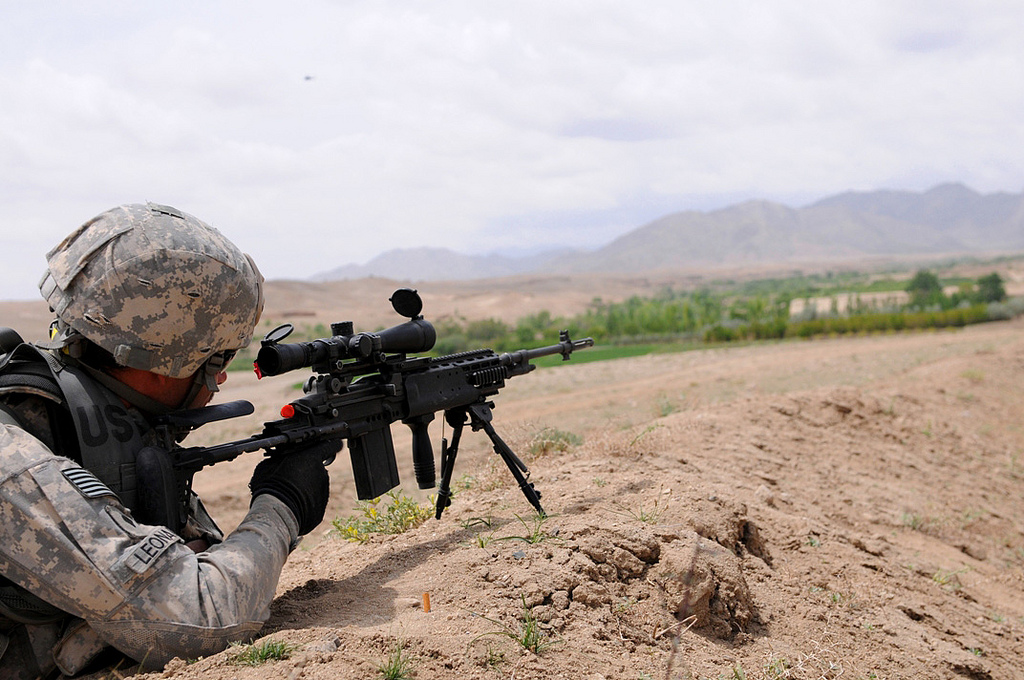

Generally, the rifles available today are mostly adequate for what’s required of them, whether it’s for hunting or tactical shooting. However, this article specifically looks at the Remington rifles delivered to the market in recent decades and how they evolved.
Remington Model 700SS 5-R Milspec
In the nineties, the Remington 700P in .308 was a quality rifle although some disadvantages included its long throat, which required seating the bullets beyond the magazine length for best accuracy. Regardless, it was still an excellent rifle.
However, unless you’re a shooter who keeps abreast of the goings on in the industry, you probably won’t be familiar with the Remington Model 700SS 5-R Milspec. Named after the barrel, the 5-R Milspec indicates the rifling used. Remington offered this rifle through one national supplier in the early 2000s. Its principle feature was the stainless steel M700 action and barrel set in an originally designed HS Precision varmint stock. Then the HS Precision PSV74 varmint stock was introduced in 2005 with a well-shaped palm swell that allowed for perfect positioning for firm trigger control. The re-curve in the 3-inch wide forearm gave the fingers comfortable placement in offhand positions and a steady rest for benchrest shooting. Having a shorter forearm than tactical rifles, it had a great balance between feel and manageability. The barrel’s outer contour is very portable, making it easier to carry and handle over longer distances when hunting.
The bullet jacket’s smooth engraving transition considered to reduce drag in flight, ease of cleaning and proven accuracy are just some of the advantages this rifle offers. Furthermore, the 700SS’s trigger weighs 5 pounds compared to the normal 8 pound triggers found on most rifles, and it also has a reasonable chamber, so you don’t need extreme loading practices for pure accuracy.
To get started with testing the rifle, a batch of cartridge were loaded using Remington brass, 43 grains of Varget, CCI Benchrest primers and the 175-grain Sierra Match King bullets. After experimenting with seating depths, the bullets seated at the recommended SAMMI length of 2.8″ proved the best. Because this rifle is frequently used in F class competitions, hand loads were used for range testing. Starting with the IMI 175 grain match for break-in purposes, the rifle’s grouping was satisfactory at about an inch at 100 yards with each shot being a cold bore shot from a new barrel.
There are differing opinions with break-in procedures, so a balanced approach was taken with shooting 10 rounds with cleaning after every shot using Hoppes M-Pro 7 and a bore brush to clear carbon deposits), after which dry patching was applied and Shooters’ Choice for copper fouling. After breaking it in, five round groups were shot between cleaning.
Next, using 200 yard benchrest targets set at 100 yards with a 10x magnification and OAL was about 2.885”, the results were decent around .6 inches Then using factory length loads, 2.800″ long like Federal GM or hunting ammo, the first three rounds produced .192″ at 100 yards. After experimenting with various charges and seating depths, the rifle performs best with 2.8” OAL and a muzzle velocity of approximately 2575 fps. When tested the following day at 200 yards alongside the Remington 700P, the 700SS was an outright winner turning out groups in the .3 MOA range. The best from the 700P was .4 MOA (.75 inches) at 200 yards.
In summary, the Remington 700SS 5R Milspec is without a doubt one of the most accurate out-of-the-box .308 rifle that’s capable of true sub half MOA accuracy and tolerated the variables it was exposed to during the experiments.
BONUS OFFER: Get your free shooting range targets to print at home!
Get your free targets to print at home!
Remington 700 Police Sharp Shooter (PSS)
The Remington 700 Police Sharp Shooter (PSS) has been widely used in law enforcement agencies in the United States. Its design was based on the old Remington 700 Varmint rifle, but has evolved with increasing accuracy.
The Remington action boasts strength, rigidity, and safety, and many custom rigs and manufactured rifles were built on the 700 PSS. Currently, the PSS features the HS Precision kevlar with a fiberglass-reinforced synthetic stock and full-length, aluminum bedding block. The PSS does not have an adjustable length-of-pull stock and it has the same contour as the current Remington varmint rifles. It has a solid stock without the added weight and a wide fore grip and stability. The stock is black with a non-slip pebbled finish with a palm swell at the pistol grip for easy trigger control.
On the downside, the PSS has an unacceptably long throat and a heavy trigger. The long throat means there’s no pressure spike when seating a handloaded bullet too long, but it also prevents seeing the rifle’s true accuracy potential with a standard length cartridge. The PSS tested in this context proved to be a solid .6 MOA rifle with factory loads. With handloads, it will easily shoot into the .3 MOA range and sometimes beyond. Aside from the throat length, the PSS tactical rifle is reliable, accurate, and consistent with a cold barrel shot (CBS) being centered and one-quarter inch high of the average group.
The heavy trigger gives too much pull weight. Fortunately, Remington triggers can be adjusted so lowering it to three pounds is do-able. The trigger is wide, clean and doesn’t have creep. The only con is the weight that could affect accuracy.
In summary, the Remington 700 PSS comes highly recommended for tactical shooting.
The Remington 700 VS
The Remington 700 VS is an affordable and accurate factory rifle, with few differences to the 700 PSS. The 700 VS comes with an HS Precision stock that is fully aluminum-bedded from grip to tip to eliminate common issues with inferior bedding. Most Remington actions can be used with these stocks without reducing accuracy when torqued to the recommended 65 inch-pounds.
It features a 26″ free-floated barrel, and concave crowned muzzle, with both the barrel and receiver having a matte finish. The fore grip is wide enough to give a stable rest and has one sling swivel stud. You can add a second stud for a bipod, which is a simple job.
Using the factory trigger, the rifle is can sustain precision fire on the smallest targets and the test results were good without any tuning required. While it may not be the right choice for competing at benchrest, it’s more than suitable for police sharpshooting, or varmint hunting. When using non-match grade ammunition to break it in, the results gave on average a .850 MOA and after this process, results went to about .750 MOA. Then after developing handloads, it shot an easy .400 MOA range.
Being a high-quality rifle with superior metal work, there are no obvious blemishes or rough spots, and mounting a scope didn’t require any adjustments. However, the trigger weighs about 8 pounds, which can be easily adjusted to 3 pounds.